

The Challenge of Gulf Color Fading and Metamerism
Automotive finishes in Qatar are exposed to intense UV radiation and ambient temperatures regularly exceeding 48°C during peak summer months. Over time, clear coats yellow microscopically and pigment molecules shift in spectral reflectance. When a bodyshop repairs a damaged fender or door panel, simply mixing according to the factory paint code often results in noticeable mismatches due to solar aging.
Multi-Angle Optical Analysis
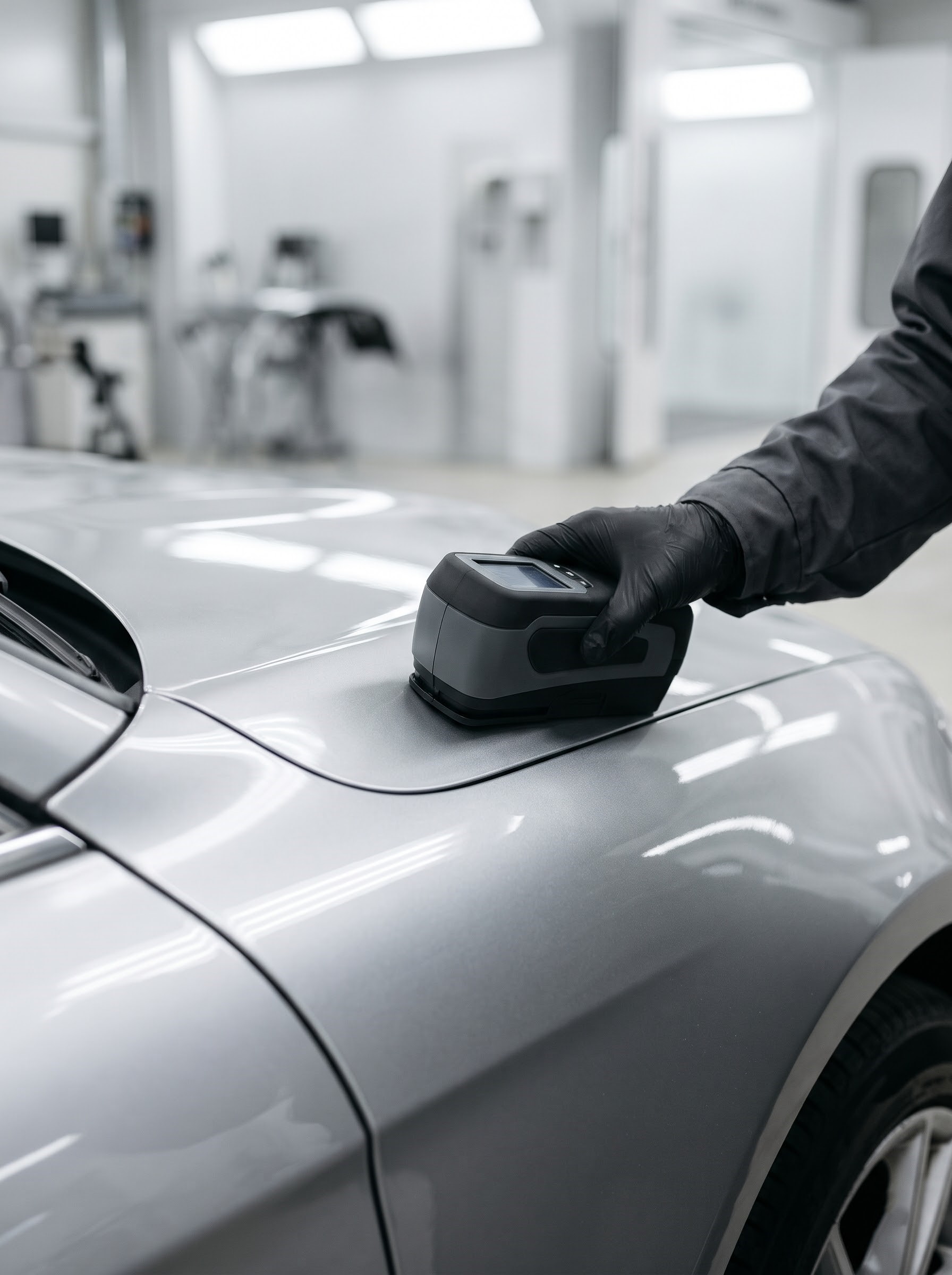
Our Wakalat Street technical center utilizes 5-angle digital spectrophotometers calibrated against Axalta and HB Body cloud formula databases containing over 250,000 global OEM variants. By capturing reflected light at 15°, 25°, 45°, 75°, and 110°, the optical sensor analyzes both the base pigment color and the flop-effect of metallic and pearlescent flakes.
Delta E Tolerances Explained
A Delta E (ΔE) value below 1.0 is generally undetectable by the human eye under direct sunlight. Our automated mixing protocols consistently achieve ΔE < 0.3 on European luxury, Japanese, and American automotive finishes.
Computerized Dispensing & Micro-Tinting
Once the closest match is calculated by software, our automated scales meter high-pigment toners with 0.01g precision. Test spray-out cards are dried using infrared curing lamps and evaluated under D65 daylight simulation booths before final formulation delivery to client workshops.